 English
 Italiano
 Français
 Español
 Deutsch
- label News
Written by Paola Piazzi
Dust and light fractions affect the quality of recycled material and the stability of the line. How to design extraction right on the machine.
Two recycling plants can process similar materials with equivalent machines and still get different results. There are many possible causes: input material, sorting, shredding, washing, drying. One of them is often the last to be designed: dust extraction.
When it is conceived as part of the line, extraction does more than keep dust in the workplace under control. It removes fines and light fractions, keeps the material clean and, above all, stabilises process conditions. For manufacturers of shredders, granulators, separators and complete lines, this means considering it from the very start of machine design.
What does dust extraction do in a recycling plant?
Extraction captures dust, fine fractions and, in some applications, light fractions where they are generated: shredding, grinding, screening, transfer points. The airflow is then conveyed through ducting to cyclone separators and industrial filters, where the captured material is separated from the air.
In the recycling of plastics, wood, paper, rubber and WEEE, it therefore plays a dual role: it controls dust and is part of the production process. An overview of our solutions for the sector is available on the Recycling and waste disposal page.
Which defects in recycled material are caused by dust and light fractions?
Not all of them. But when there is too much dust, fines and light contaminants, the problems show up in the downstream stages.
| Problem | Possible origin | Role of extraction |
|---|---|---|
| Fines in the material | Shredding and grinding | Removes them at the source |
| Residual film, paper, labels | Insufficient separation of light fractions | Pneumatic separation |
| Poor material flowability | Excess fines | Reduces dust and fines |
| Quality varying during the shift | Unstable extraction conditions | Filter and pressure drop management |
| Presence of impurities | Contaminants, thermal degradation, fines | Reduces the possible causes |
The distinction to keep in mind is between direct cause and contributing cause. Extraction does not fix every issue on the line, but it prevents dust and unwanted fractions from compromising the downstream stages.
Why does recycled material quality changes during the different work phases?
There can be several causes, including the extraction system. As dust builds up on the filters, the airflow drops and the system captures fewer fine fractions, which remain in the material and, as they degrade, form black specks. Automatic filter cleaning keeps the airflow constant and, with it, the quality of the recycled material
This matters most when the airflow is also used for pneumatic separation. With too little airflow, light fractions stay in the material. With poorly sized conditions, good product gets carried away. That is why stability matters as much as nominal capacity.
Cleaning systems controlled by differential pressure, like the economisers, keep the filter within its intended operating range and reduce compressed air consumption.
Stability also matters for downstream equipment. On lines with optical sorting, keeping dust away from the detection area reduces cleaning and keeps the sensors in their intended conditions. Extraction should be designed with what it needs to protect in mind, not just the point where the dust is generated.
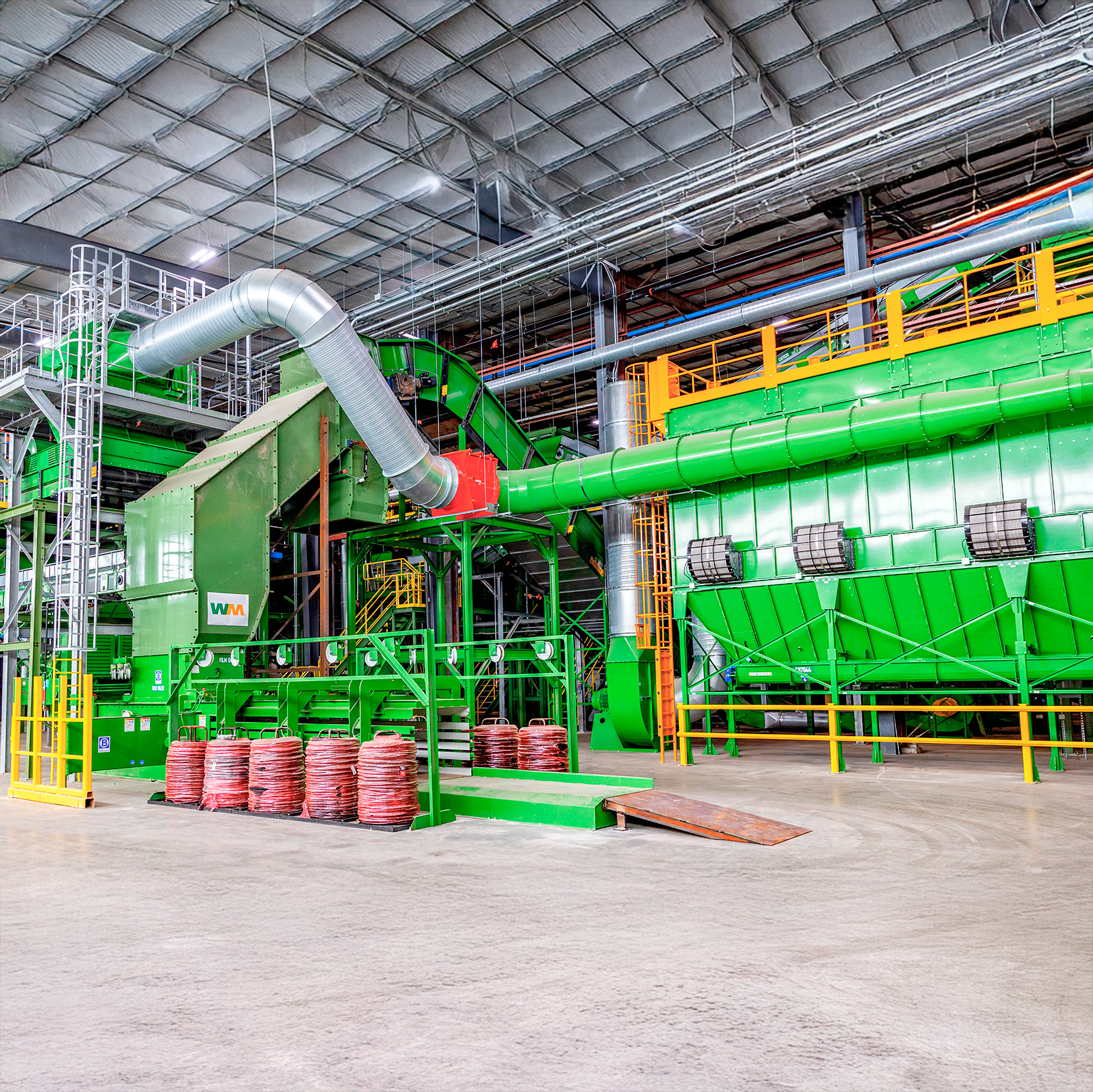
Bag filter Pulco Air in a recycling plant
What are the risks of insufficient extraction?
The risks go beyond material quality. There are more deposits on the machines, more downtime for cleaning, and separation becomes less repeatable.
Then there is safety. Some recycling dusts are combustible and, under certain conditions, can form explosive atmospheres. The risk is assessed case by case: dust characteristics, concentrations, ignition sources, plant configuration. Where the risk exists, extraction, equipment and protection systems must be defined in accordance with the ATEX directives & NFPA standards and the plant risk assessment. In WEEE recycling, the possible presence of batteries must also be taken into account. For an in-depth look at how to protect the entire circuit, filter and cyclones together, see our real-world case of active suppression to NFPA standards.
How do you design dust extraction for a recycling plant?
You start from the process, not from the filter.
1. Capture where the dust is generated. Shredders, granulators, screens and transfer points have different requirements. When capture is close to the source, dust is intercepted before it disperses and lower airflows are needed.
2. Size the system on the real material. Fine dust, fibres, film and heavy particles behave differently in the airflow. Particle size, dust load and airflow all count, not just the size of the machine. The same principle applies to bulk material handling: there is no such thing as a universal filter.
3. Consider pre-separation. If the airflow contains a lot of coarse particles, a cyclone separator such as the AREN upstream of the filter reduces the load on the filter elements.
4. Filter the residual dust. The technology is chosen according to the dust and the operating conditions. Several solutions are available: OPF horizontal cartridge dust collectors, Modul Air ATEX or, where airflows and dust types require it, Pulco Air baghouse filters.
5. Control the pressure drop. Monitoring differential pressure and managing the cleaning of the filter elements keeps the system at its design conditions.
6. Build in safety from the start. Fire and explosion protection measures are not added once the plant is finished. They are defined together with the machine and the extraction system, starting from the characteristics of the dust.
7. Consider an on-board solution. For an OEM, treating the machine and the extraction system as two separate systems complicates installation and commissioning at the customer's site. A compact filter such as the Kompac Air MJT makes it possible to integrate extraction and filtration into the machine configuration.
FAQ: dust extraction in recycling plants
Does extraction improve the quality of recycled material?
Yes, when it removes dust, fines and light fractions that would otherwise remain in the material. The final quality still depends on the entire process and on the input material.
Why does recycled material have impurities?
The most common causes are contaminants in the incoming material, residues from previous processing runs and thermal degradation of the polymer. Fine dust can also play a part: if it is not extracted, it stays in the material, degrades during melting and forms black specks.
Why does extraction performance change during the shift?
Because dust build-up on the filter elements increases the pressure drop. Managing cleaning and monitoring differential pressure keeps the system at its design conditions.
Is dust from recycling plants dangerous?
Some dusts are combustible and can generate explosive atmospheres. The risk must be determined through a specific assessment of the dust, the process, ignition sources and the plant.
Do I need a cyclone or a filter?
It depends on the application. If the airflow contains both coarse particles and fine dust, cyclonic pre-separation before filtration reduces the load on the filter.
Want to integrate dust extraction into your recycling machine or line? Contact TAMA AERNOVA: we will assess the process, material and dust with you to define the most suitable configuration.